
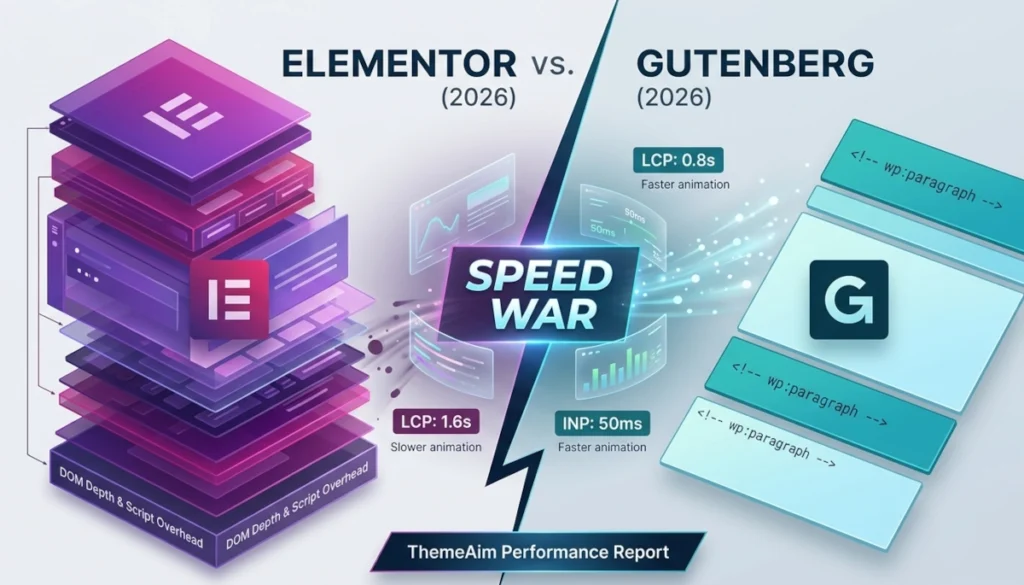
For years, the WordPress ecosystem faced a fundamental trade-off: infinite design flexibility vs. raw loading speed. In one corner stood third-party page builders like Elementor, providing intuitive drag-and-drop mechanics. In the other corner sat Gutenberg, the native block editor built into the core of WordPress.
As core site metrics evolve, this performance debate is no longer about personal preference – it’s a critical financial decision. With Google heavily prioritizing user experience and speed metrics like Interaction to Next Paint (INP) and Largest Contentful Paint (LCP), the tool you choose to render your site determines your baseline visibility.
Let’s break down the technical differences between Elementor and Gutenberg to determine which framework wins the performance war today.
1. The Code Architecture: DOM Depth and Bloat
To understand why one builder loads faster than another, we have to look behind the visual user interface at the rendered HTML source code.
The Elementor Markup Paradigm
Historically, Elementor has depended on a nesting container system. While its transitions and responsive adjustment systems are incredibly powerful, they introduce a phenomenon called DOM Bloat. A simple paragraph block in Elementor can easily wrap your text in three or four nested <div> layers to handle columns, margins, padding, and layout alignments.
When a browser renders an Elementor page, it must parse complex, deep Document Object Model (DOM) trees. This extra weight increases your time-to-first-render and consumes more client-side processing memory.
The Native Gutenberg Blueprint
Gutenberg operates directly on the native engine of WordPress. Instead of creating dynamic wrappers around elements, Gutenberg saves structural configurations within clean, classic HTML comment tags (“).
When a user requests a Gutenberg page, WordPress renders almost pure HTML to the client browser. The DOM tree stays incredibly flat, allowing browsers to render layout elements almost instantaneously.
- Winner on Code Architecture: Gutenberg. The structural footprint is significantly smaller, providing a cleaner execution environment.
2. Core Web Vitals Performance Breakdown
Let’s look at how both ecosystems stack up against Google’s critical user-experience performance benchmarks.
Largest Contentful Paint (LCP)
LCP measures how long it takes for the primary, largest piece of content on a page to become visible.
- Gutenberg: Because Gutenberg requires minimal external CSS files and zero rendering JavaScript engines out of the box, above-the-fold media assets and header elements load nearly instantly.
- Elementor: Elementor has introduced incredible optimizations over time, such as asset loading control and lazy loading elements. However, it still loads secondary scripts and layout configurations that can delay your final LCP rendering window if not paired with high-performance caching.
Interaction to Next Paint (INP)
INP measures the responsiveness of a page when a user performs an action, like clicking a mobile navigation button or interactive menu.
- Gutenberg: By avoiding main-thread processing blockages, Gutenberg scores exceptionally high on interaction speed out of the box.
- Elementor: Elementor provides massive flexibility for layout creation. However, if your page includes multiple heavy scripts, complex form builders, or motion effects, your main thread can become congested. This congestion requires careful optimization to prevent mobile input lag.
3. The Modern Theme Dynamic: Block Themes vs. Classic Frameworks
The page builder landscape changed dramatically with the introduction of Full Site Editing (FSE).
With block-based themes, Gutenberg allows you to control headers, footers, sidebars, and dynamic templates natively using the block editor. This evolution eliminates the need to run heavy theme frameworks plus a secondary structural system.
Conversely, Elementor operates on top of your underlying theme engine (even lightweight ones like Elementor Hello). While it gives you complete visual control over theme builders, it adds an administrative layer. The browser must resolve both the active theme logic and the Elementor template configurations simultaneously.
4. The Verdict: Which Framework Fits Your Goal?
| Criterion | Elementor Ecosystem | Native Gutenberg Block Ecosystem |
| Raw Out-of-the-Box Speed | Good (Requires active optimization) | Exceptional (Fast by default) |
| Design Control Complexity | Unlimited (Zero code required) | Moderate (Requires solid block knowledge) |
| Plugin Dependency | High (Often requires addons for features) | Low (Mainly uses core functionality) |
| Long-Term Scalability | Excellent for visual marketing teams | Best for developers & large enterprise content hubs |
Choose Gutenberg If:
Your business model relies heavily on rapid content delivery, mobile optimization, SEO visibility, and high performance right out of the box. If you run a high-traffic blog, content hub, news site, or a fast-loading lightweight portfolio, Gutenberg’s clean code approach will make hitting target Core Web Vitals metrics much easier.
Choose Elementor If:
You run a digital agency, complex conversion landing pages, or an e-commerce storefront that demands advanced, intricate motion graphics, custom column grids, and interactive widgets without writing a single line of custom code. With proper hosting, robust page-caching, and image asset optimization, an Elementor setup can deliver highly interactive designs at scale.
Final Thoughts for ThemeAim Users
Choosing a builder isn’t about finding the single “best” tool – it’s about matching your project’s performance requirements with your team’s workflow.
If you choose a block theme framework for speed, ensure you use well-optimized plugins. If you prefer the complete visual design control of Elementor, complement your layout with clean development practices: minimize nested containers, optimize images before uploading, and use lightweight asset management plugins.
Explore ThemeAim’s premium theme collections to find the perfect architecture for your next web project!