
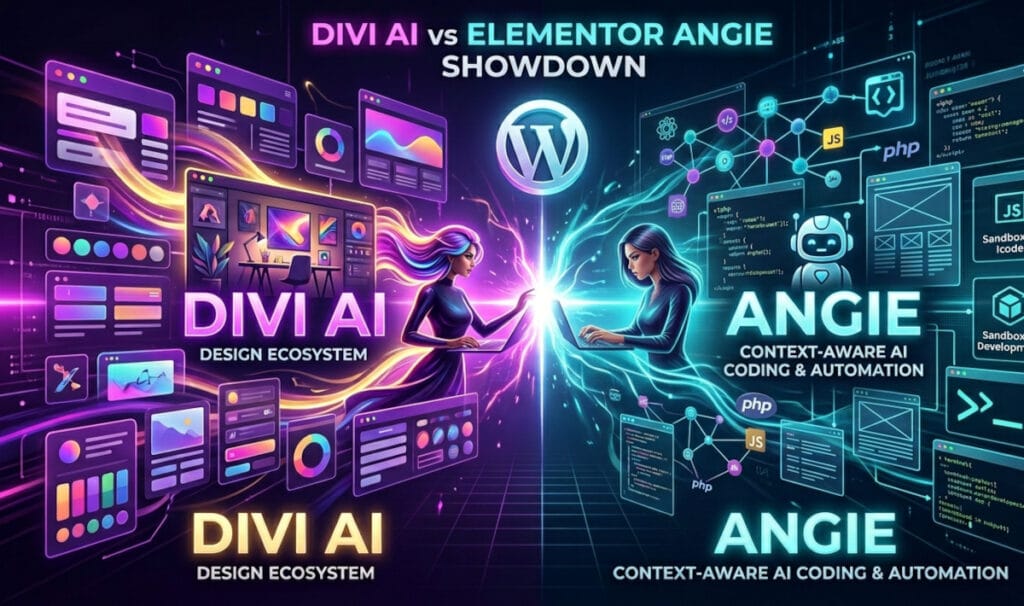
The conversation around WordPress development has fundamentally shifted. We are no longer simply comparing visual drag-and-drop mechanics, arguing over columns, or debating the density of built-in element libraries. Instead, the modern frontier of web creation is defined by contextual intelligence – specifically, how deeply artificial intelligence can integrate into your site’s foundation to act as an active collaborator rather than a passive assistant.
Two tech giants dominate this new era with completely distinct approaches: Divi AI by Elegant Themes and Angie by Elementor. Choosing between them isn’t just a matter of picking a feature set; it’s an architectural decision that alters your development speed, code footprint, and long-term site scalability.
Here is the definitive, deep-dive breakdown between the market’s leading AI design ecosystem and its most powerful agentic workflow framework.
The Quick-Glance Comparison
| Feature / Metric | Divi AI (Elegant Themes) | Angie (Elementor) |
| Core Architecture | Integrated Design System & Asset Studio | Context-Aware AI Coding & Automation Agent |
| Primary Strength | On-the-fly creative asset generation, visual continuation, and inline micro-CSS adjustments. | Global structural updates, sandbox tasks, and dynamic custom widget programming. |
| Best For | Visual designers, marketing agencies, and freelancers prioritizing swift aesthetic turnarounds. | Developers, technical power-users, and creators requiring bespoke programming architecture. |
| Code Control | Medium (Automates code wrapped in module shortcodes). | High (Generates raw, sandboxed WordPress assets and native hooks). |
1. Elementor’s Angie: The Agentic Workflow Framework
Elementor’s Angie represents a massive paradigm shift by introducing true agentic AI to the WordPress ecosystem. It isn’t just a helper utility bolted onto a text box to rewrite headings or tweak standard typography settings. It functions as an autonomous junior developer directly inside your WordPress dashboard.
[Natural Language Prompt] ──► [Angie Agentic Engine Evaluates Database Rules] ──► [Isolated Sandbox Testing] ──► [Live Production Deployment]The Standout Capability: Context-Aware Code Automation
Angie’s flagship superpower is its absolute structural awareness. Because it maps the active plugins, database parameters, and active global style patterns of your entire installation, it acts intentionally. Through its core programming framework, you can type a natural language prompt, share a reference URL, or upload a rough wireframe image. The engine interprets this input to write fully editable custom Elementor widgets, frontend interactive elements, and sophisticated backend PHP functions from scratch.
- The Practical Workflow: Instead of spending hours hunting through the WordPress repository or writing complex custom code for a specific feature, you prompt Angie: “Create a dynamic quote calculator widget with a slider that changes values based on custom user parameters, and ensure it inherits our global design tokens.” Angie builds the widget, hooks it natively into Elementor, and formats the architecture cleanly.
- The Isolated Sandbox Architecture: Crucially, Angie avoids writing directly to production files. Everything it generates runs first inside an isolated web-sandbox environment. You can interact with the feature, prompt modifications via chat, and deploy it to your live page architecture only when performance and styling match your exact technical constraints.
Angie Strategic Advantage: Angie is a structural powerhouse. It treats your theme framework as a logical software system, allowing you to bypass hours of manual backend configuration and tedious template building.
2. Divi AI: The Seamless Design Powerhouse
Where Elementor’s Angie acts like an engineering and logic partner, Elegant Themes’ Divi AI functions as an integrated, multi-disciplinary digital design studio. Trained natively on Divi’s massive proprietary codebase, module layers, and styling configurations, this system is engineered to eliminate creative friction and build visually stunning canvases entirely from the front-facing page builder.
The Standout Capability: Visual Continuity & Asset Integration
Divi AI excels remarkably at contextual visual continuation. Because the AI analyzes the exact dimensions, color palettes, spacing parameters, and structural components surrounding any given block, it generates assets that blend seamlessly with the brand’s established look and feel.
- Unified Asset Generation: Divi AI features built-in high-resolution image generation, image-to-image styling modifications, and a powerful textual layout engine. If you need a striking background graphic or contextual marketing copy, Divi AI crafts it based directly on what is already live on the page.
- Inline Micro-CSS Control: If a specific grid layout or hover effect requires styling properties beyond the standard module options, you don’t have to navigate away to a global stylesheet. The inline prompt tool writes specific, valid CSS targeted directly to that unique element ID, preserving your visual workflow without disruptive context switching.
Divi AI Strategic Advantage: Divi AI is a visual powerhouse. It minimizes asset procurement friction, allowing agencies to go from a rough brief to fully styled, client-ready layout concepts without needing external graphic tools or premium stock subscriptions.
Head-to-Head Showdown: The Critical Friction Points
Friction Point 1: Prototyping Velocity & Asset Handling
- Winner: Divi AI
- When an agency or freelancer needs to spin up a beautifully fleshed-out landing page mockup under a tight deadline, Divi AI holds an undeniable edge. Its capability to generate high-quality images, refine visual backgrounds, and compose targeted copy natively on the page drastically cuts down on asset collection time. It turns abstract concepts into complete visual realities within a single, highly intuitive editing interface.
Friction Point 2: Structural Logic & Custom Functionality
- Winner: Angie (Elementor)
- For websites requiring advanced structural modifications – such as custom post type archives, dynamic conditional visibility filters, or bespoke backend database calls – Angie completely outclasses standard builders. Because it generates clean, sandboxed code components and custom modules natively compatible with the core environment, it transcends basic visual adjustments and moves into true full-site engineering.
Friction Point 3: Long-Term Performance & Code Overhead
- Winner: Angie (Elementor)
- Performance optimization is a critical pillar of modern SEO. While Divi AI builds brilliant layouts, it operates within Divi’s comprehensive framework layer, which traditionally introduces heavier database and script overhead. Elementor’s Angie focuses heavily on performance by generating precise, optimized code blocks and native elements. By minimizing the reliance on bulky third-party helper plugins to achieve custom functionality, it produces a leaner site structure with lightning-fast PageSpeed potential.
The Core Strategy & Ultimate Verdict
When selecting your core AI ecosystem, look past simple text rewriters or superficial image generators. The true value lies in aligning the platform’s native intelligence with your biggest operational bottleneck.
- Choose Divi AI if you are a visual-first designer, creative marketer, or agency whose primary bottleneck is asset collection, creative layout variation, and rapidly spinning up high-fidelity visual concepts for client approval. It delivers unmatched visual continuity and aesthetic flexibility entirely within a unified front-facing canvas.
- Choose Elementor Angie if you are a developer, technical creator, or power-user who demands clean, performant architecture alongside infinite technical customizability. Angie provides an expert conversational engineering partner right in your dashboard, turning complex theme logic and bespoke element creation into a seamless, high-speed dialogue.