
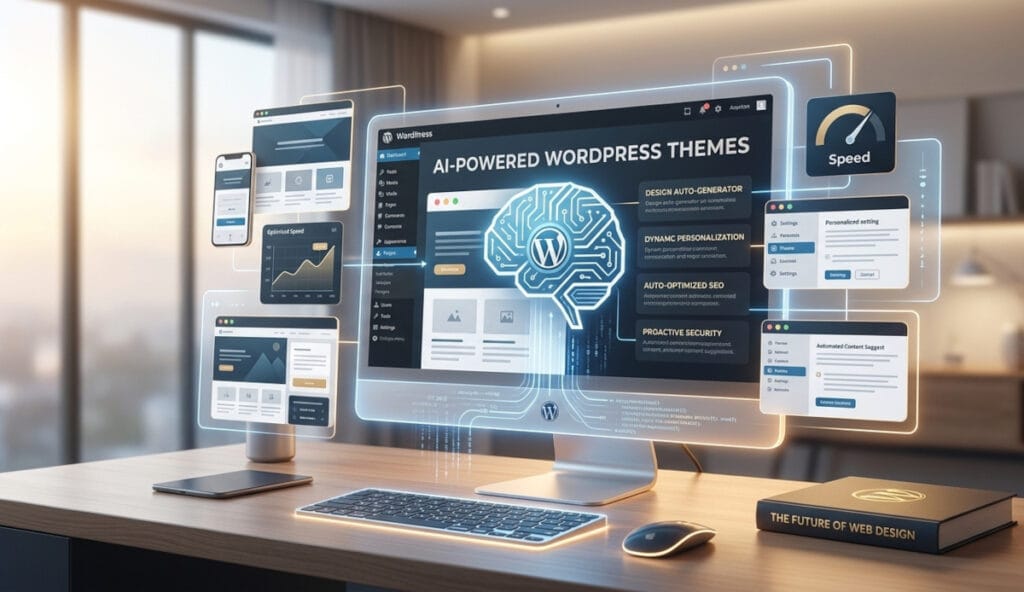
The landscape of web development is undergoing a generational shift. For decades, building a WordPress website meant choosing a rigid theme, installing a heavy page builder, and spending hours manually adjusting margins, typography, and layout hierarchies. Today, artificial intelligence is breaking those boundaries down.
What Exactly is an AI-Driven WordPress Theme?
At its core, an AI-driven WordPress theme is a website framework that integrates machine learning models and generative algorithms directly into the WordPress ecosystem (such as the Gutenberg Block Editor or popular page builders). Instead of relying strictly on static templates, these themes adapt, generate, and optimize web design layouts based on natural language prompts or context-specific user data.
Rather than replacing WordPress, AI enhances it. It turns the traditional workflow upside down: instead of searching for a template that “looks close enough” and fixing it, you describe what you want, and the AI generates the scaffolding natively.
THE PARADIGM SHIFT
“Traditional web design is deterministic—you explicitly code every behavior. AI-driven web design is probabilistic—you define the constraints, intent, and parameters, and the algorithm renders the optimal variation.”
Core Pillars of AI Integration in Modern Themes
AI-driven themes operate across three fundamental vectors within the WordPress environment:
1) Contextual Layout Generation
Often referred to as “Prompt-to-Theme,” this allows users to type a simple sentence such as “Create a minimalist portfolio page for a structural architect specializing in brutalism” and see the theme dynamically assemble structural blocks, image placeholders, and text layouts suited to that aesthetic.
2) Intelligent Copywriting & Context-Aware Media
A major bottleneck in launching a website is content. AI-driven systems analyze the selected theme layout and generate contextually appropriate headlines, body paragraphs, and call-to action buttons directly within the editor. Furthermore, they plug into neural networks to recommend or generate custom vector imagery matching your color profile.
3) On-The-Fly CSS & Design System Adaptability
Instead of browsing infinite settings menus to adjust paddings or color shades, AI engines allow developers to alter styles using simple text inputs. The system evaluates the existing global design tokens and applies harmonious, clean code changes behind the scenes.
Why You Should Transition to AI-Powered Ecosystems
Adopting an AI-centric approach to WordPress development isn’t merely about keeping up with trends; it solves real, measurable operational inefficiencies.
Drastic Reduction in Time-to-Market: What used to take design agencies days of wireframing can now be generated as a functional prototype in minutes. Developers can use generated layouts as a baseline, allowing them to focus entirely on deep customization, custom business logic, and robust conversion funnel tracking.
Clean Code and Peak Performance: Historically, page builders achieved flexibility by adding layers of bloated code (the infamous “div soup”). Modern AI generators write clean, standardized Gutenberg blocks or native CSS parameters on the fly, keeping the site light, performant, and compliant with search engine Core Web Vitals.
The Future Outlook: Predictive Web Design
We are rapidly moving from user-guided generation to autonomous optimization. The next frontier for AI-driven WordPress themes is continuous conversion optimization. Imagine a theme that seamlessly tracks visitor engagement and autonomously alters its visual layout via a programmatic feedback loop:
Context_Optimized = ƒ( User Context, Behavioral Signals, Core Theme Constraints )If the data reveals that mobile users are dropping off a checkout funnel, the AI will restructure the bento grid sequence or adjust color contrasts automatically to elevate readability and drive conversions.
AI-driven WordPress themes represent a profound evolution in digital publishing. By automating structural generation, content alignment, and asset selection, they empower creators to design beautifully unique sites without sacrificing technical performance. The barrier to entry has officially been broken.
The Future of Web Design: Unlocking the Advantages of AI WordPress Themes
The integration of Artificial Intelligence (AI) into web design is no longer a futuristic concept – it is actively reshaping how websites are built, managed, and optimized. For businesses, bloggers, and developers using WordPress, the shift from traditional static themes to AI-powered WordPress themes represents a massive leap forward in efficiency and user experience.
Here is a deep dive into the unique advantages of using AI WordPress themes for your next web project.
1) Hyper-Personalized User Experiences (UX)
Traditional WordPress themes rely on a fixed layout; every visitor sees the exact same structure and content placement. AI-powered themes break this mold by analyzing user behavior in real-time.
Dynamic Content Delivery: AI can track a visitor’s location, browsing history, and device preferences to dynamically alter what content is highlighted first.
Smart Layout Adaptations: If the AI detects that a user frequently interacts with video content rather than long-form text, it can adjust the homepage layout to prioritize media elements for that specific user.
This level of automatic personalization significantly reduces bounce rates and keeps users engaged longer.
2) Automated SEO and Content Optimization
On-page Search Engine Optimization (SEO) usually requires a handful of plugins and hours of manual tweaking. AI themes streamline this by building optimization directly into the core framework.
Real-Time Readability Adjustments: AI assistants within the theme can analyze your text as you type, suggesting improvements for readability, tone, and keyword density.
Automated Metadata: The theme can automatically generate highly optimized meta titles, descriptions, and image alt text based on the context of your page, ensuring you never miss an SEO best practice.
3) Revolutionary Speed and Performance Optimization
A slow website kills conversions. While traditional themes often get bogged down by heavy code and unoptimized assets, AI themes utilize intelligent asset loading.
Predictive Caching: AI can predict which page a user is likely to click next based on common user pathways and pre-load those assets in the background.
Intelligent Image Compression: Instead of generic compression, AI analyzes the visual data of an image to compress it to the absolute minimum file size without sacrificing crisp visual quality.
4) Effortless Layout Generation and Prototyping
The days of staring at a blank canvas or wrestling with rigid page builders are fading. AI WordPress themes often feature native prompt-based layout generators.
How it works: You type a simple instruction, such as "Create a minimalist portfolio layout for a wedding photographer with a dark theme and a prominent testimonial section." The AI processes the request and generates a fully coded, responsive layout in seconds. This drastically reduces development time, allowing agencies and freelancers to prototype sites for clients at unprecedented speeds.
5) Enhanced Security and Predictive Maintenance
WordPress sites are frequent targets for hackers. AI themes act as an embedded, proactive security guard rather than a reactive firewall.
Anomaly Detection: By establishing a baseline of normal site behavior, the integrated AI can instantly flag unusual traffic spikes, unauthorized login attempts, or code injections.
Self-Healing Capabilities: If a plugin update breaks a minor element of your theme’s layout, advanced AI frameworks can detect the rendering error and automatically apply a temporary patch or roll back the change before your visitors notice.
AI WordPress themes are shifting the paradigm from static design to intelligent automation. By handling the heavy lifting of coding, SEO, speed optimization, and security, they allow creators to focus entirely on what matters most: strategy and content. For anyone looking to build a futureproof website, investing in an AI-driven ecosystem is the ultimate competitive advantage.
Traditional WordPress Themes vs. AI-Driven Frameworks
For over a decade, building a website on WordPress followed a predictable, comfortable script. You purchased a domain, found a hosting provider, and browsed a marketplace like ThemeForest to find a “theme” that matched your vision. You tweaked some CSS, uploaded a logo, and called it a day.
But the landscape of web development is undergoing a massive shift. The rise of artificial intelligence has introduced a new contender to the ring: AI-Driven Layout Frameworks. If you are planning a new web project, understanding the fundamental differences between these two methodologies is crucial. Let’s break down how traditional WordPress themes stack up against their new, intelligent counterparts.
What is a Traditional WordPress Theme?
A traditional WordPress theme is a pre-packaged bundle of files (PHP, CSS, JavaScript, and HTML) that dictates the visual appearance and layout of your website.
The Apartment Analogy: Think of it like a rented, fully-furnished apartment. The walls are painted, the furniture is placed, and the plumbing is hooked up. You can swap out the art on the walls (images) or move a chair (basic widgets), but changing the core architecture requires major structural remodeling (custom coding).
The Pros:
Instant Visual Gratification: You see exactly what you are buying before you install it.
Massive Ecosystem: Millions of tutorials, plugins, and developer forums exist to help you troubleshoot.
Budget-Friendly: High-quality premium themes can be purchased for a one-time fee of $40 to $100.
The Cons:
Code Bloat: To appeal to a mass market, creators pack themes with dozens of features you’ll never use, slowing down site performance.
The “Cookie-Cutter” Trap: Your site will likely look identical to thousands of other businesses using the same theme.
What is an AI-Driven Framework?
An AI-driven framework does away with static templates entirely. Instead of forcing your content into a pre-existing box, it utilizes machine learning algorithms to build a custom framework around your specific goals.
The Architect Analogy: Instead of a furnished apartment, an AI framework is like a robotic architect. You tell the AI: "I want a mid-century modern home with three bedrooms, optimized for natural morning light," and it generates a blueprint and builds it from scratch in seconds.
Platforms like Elementor AI, Divi AI, and standalone AI builders ask for your industry, brand voice, and content goals, then dynamically generate bespoke layouts, copy, and asset placements.
The Pros:
True Hyper-Personalization: Layouts are mathematically optimized for your specific target audience and content hierarchy.
Dynamic Adaptation: Advanced AI frameworks can automatically adjust layouts based on real-time user behavior analytics to maximize conversions.
Rapid Prototyping: You can generate five completely different website iterations in under ten minutes just by tweaking your text prompts.
The Cons:
The “Black Box” Problem: If the AI generates an error or an awkward design anomaly, troubleshooting it can be difficult without digging into complex backend code.
Subscription Dependencies: Many AI tools rely on cloud-computing API credits, meaning ongoing monthly costs rather than a one-time theme purchase.
Head-to-Head Comparison
| Feature | Traditional WordPress Themes | AI-Driven Frameworks |
| Design Starting Point | Pre-made templates and rigid demos. | Intent-based prompts and dynamic generation. |
| Performance & Speed | Often slowed down by legacy code bloat. | Leaner, modular code generated on demand. |
| Customization Effort | High. Requires manual layout adjustments or coding. | Low. Conversational prompts handle complex design shifts. |
| SEO & CRO | Dependent on user knowledge and third-party plugins. | Built-in algorithmic optimizations for conversion and search. |
Performance and Clean Code: The Hidden Battlefield
One of the biggest arguments for moving away from traditional themes is performance. Traditional themes often suffer from “div soup” and heavy JavaScript dependencies because they have to accommodate every possible layout permutation a user might choose. This can negatively impact your Google Core Web Vitals.
AI frameworks, conversely, are progressively moving toward just-in-time (JIT) code generation. The AI compiles only the exact CSS and semantic HTML needed to render your specific layout, resulting in blistering fast load times right out of the gate.
The Final Verdict
Choose a Traditional Theme if…
You are on a tight budget, need a reliable, time-tested solution, and find comfort in knowing that a human designer meticulously crafted every pixel of the demo site. It remains an excellent choice for straightforward blogs, portfolios, and local businesses.
Choose an AI Framework if…
You want a unique digital footprint, prioritize rapid scaling, and want your layout driven by data rather than aesthetic guesswork. It is the superior choice for agile startups, e-commerce brands, and fast-paced digital agencies.
The Best AI WordPress Theme Frameworks
The Shift to Intelligent Ecosystems & Intelligent Site Building
For years, a WordPress theme framework meant a rigid structural skeleton like Genesis, Sage, or Underscores. Developers used them to avoid writing standard theme code from scratch.
Today, the ecosystem looks completely different. The rise of agentic AI – artificial intelligence that actively plans, executes, and optimizes tasks rather than just spitting out static code snippets has merged traditional theme frameworks with intelligent page builders.
Instead of writing custom hooks or manually wrestling with CSS media queries, modern creators use AI frameworks to prototype, structure, code, and optimize site speeds entirely from the dashboard. The following five options stand out as the premier AI WordPress theme frameworks and site builders changing the landscape.
1) Angie by Elementor: The Native Agentic Framework
If you want a true developer-focused framework that functions as an intelligent collaborator, Elementor’s native Angie framework represents a massive leap forward.
Unlike standard AI helpers that simply generate text or basic layout sections, Angie acts as an autonomous agent deep within the WordPress environment. It understands the context of your entire site asset architecture.
How it works: You communicate with the framework in plain English. For example, you can tell it to “Create an archive page layout for a custom post type called ‘Properties’ and sync it with our global CSS variables,” and Angie will execute the changes globally.
Best for: Developers and advanced creators who want to eliminate repetitive coding tasks while maintaining deep control over theme architecture.
The Verdict: Angie is arguably the most forward-thinking tool for custom WordPress building. It treats the site structure like a conversation, dramatically slashing development time.
2) Divi AI (Elegant Themes): The Seamless Design Ecosystem
Elegant Themes’ Divi has long been a heavyweight in the WordPress ecosystem. With Divi Pro and Divi AI, it functions less like a simple layout tool and more like an intelligent design system.
The core advantage of Divi AI is its extreme contextual awareness. Because the model is trained natively on Divi’s proprietary codebase, it understands how every module, column, and global style interaction behaves.
Standout features: Divi AI features powerful code generation capabilities (instantly generating custom HTML and responsive CSS directly within a block). It also boasts excellent image generation and text styling that adapts on the fly to match your existing brand voice and palette.
Best for: Freelancers and agencies who require an all-in-one system capable of generating highly polished, visually intricate layouts with zero asset switching.
The Verdict: While the UI can feel overwhelming to absolute beginners, its design flexibility and unlimited use" model make it highly cost-effective for scaled operations.
3) CodeWP: The Developer’s Scripting Framework
Unlike visual builders, CodeWP is a specialized AI framework built specifically for the backend mechanics of WordPress theme and plugin development. It doesn’t generate columns or images; it generates flawless, contextual PHP, JS, and SQL.
The Core Strength: CodeWP is trained specifically on the WordPress Codex, WooCommerce APIs, and major theme hooks. If you need to inject complex, custom functionality into a lightweight child theme without bloat, you tell CodeWP what you need (e.g., “Write a custom function that hooks into WooCommerce checkout to calculate a dynamic packing fee based on cart weight”).
Best for: Intermediate to advanced developers who use lightweight foundational frameworks (like Sage or Underscores) and want an AI assistant that understands WordPress core architecture without introducing plugin overhead.
The Verdict: It's the ultimate tool for maintaining a "clean code" philosophy while leveraging AI to skip hours of manual documentation lookups.
4) 10Web AI WordPress Builder: Automated Speed & Migration
While frameworks like Angie and Divi focus on the creative design process, 10Web looks at infrastructure and automated scaling. Built on top of a customized, lightweight Elementor engine, 10Web specializes in rapid generation and site cloning.
The Core Strength: 10Web’s standout selling point is its optimization engine. During the AI generation process, it modifies and manages the underlying site architecture to guarantee a 90+ PageSpeed score right out of the box, cleanly optimizing Core Web Vitals automatically.
Best for: Rapid prototyping, client site migrations, and small business MVPs (Minimum Viable Products) that need maximum speed with minimum backend configuration.
The Verdict: If you need to point to a competitor's site, mirror its underlying layout structure into a clean, native WordPress theme inside of five minutes, and ensure it loads instantly, 10Web is built precisely for that workflow.
5) ZipWP (With Astra): The Quick-Launch Blueprint
ZipWP approaches theme generation from a blueprint perspective. Created by the core engineering minds behind Astra (one of the most popular lightweight themes in the world), ZipWP uses AI to build fully functional, customized starter templates in under a minute.
[User inputs project description]
│
▼
[ZipWP generates structure]
│
▼
[Loads onto lightweight Astra Base] ──► [Zero bloat, ready for Elementor/Gutenberg]
How it works: Instead of relying on heavy visual builder scripts, ZipWP sets up a clean WordPress environment, assigns an optimized child theme, creates custom pages, and writes localized copy based on your initial prompt.
Best for: Agencies needing to rapidly spin up structural wireframes or live staging sites for client approval without adding heavy database bloat.
The Verdict: Because it relies heavily on native blocks and the Astra theme structure, it offers fantastic long-term code stability and bypasses the "vendor lock-in" issues common with proprietary visual frameworks.
Summary Matrix: Choosing Your Framework
| Framework / Builder | Primary Strength | Best For | Code Overhead |
| Angie (Elementor) | Agentic task execution & framework control | Developers & Power Users | Minimal (Highly optimized) |
| Divi AI | Deep design ecosystem & asset generation | Visual Designers & Agencies | Medium (Feature rich) |
| CodeWP | Deep Codex understanding & PHP/JS generation | Backend Developers & Tech Customizers | Zero (Outputs raw, clean code) |
| 10Web | Guaranteed performance & layout mirroring | Quick MVPs & Business Sites | Low (Managed optimization) |
| ZipWP | Lightweight, native core blueprints | Clean, fast wireframing | Very Low (Standard native code) |
The Core Strategy
When choosing how to build your next site, look past simple “text generation” wrappers. The best frameworks are those that deeply understand the underlying WordPress hierarchy – handling database logic, responsive design parameters, and performance optimization autonomously.
For complete creative styling and asset generation, Divi AI leads the market. If your goal is raw, agentic automation that handles the heavy lifting of custom development, Angie is setting the gold standard for how modern WordPress engineering gets done.