
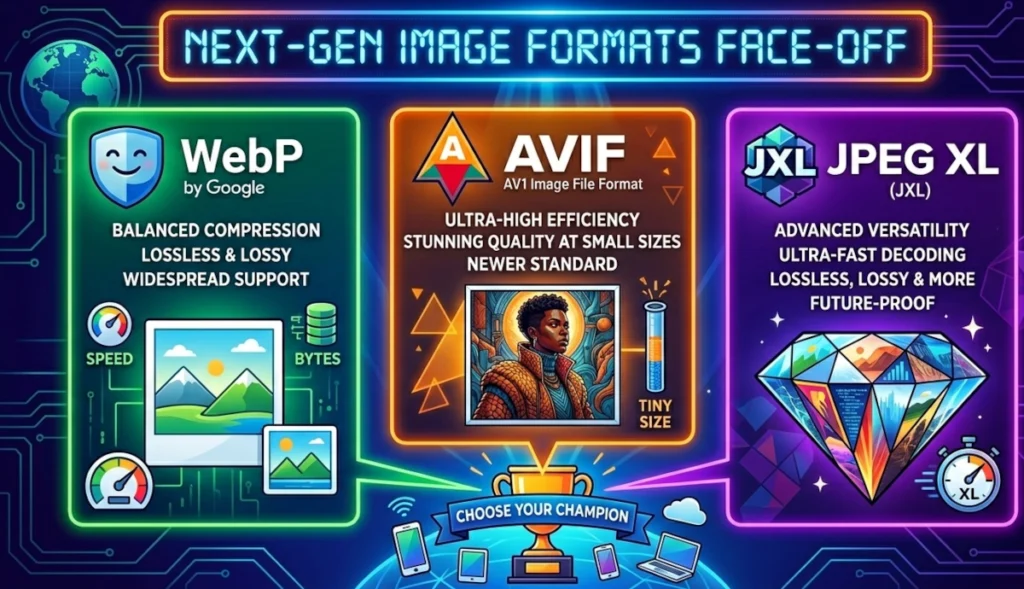
Optimizing web media used to be simple: compress JPEGs for photos and minimize PNGs for graphics. However, the requirement for instantaneous load times and richer user experiences has sparked a modern format war. While WebP successfully disrupted the old standards, two advanced contenders – AVIF and JPEG XL (JXL) – are redrawing the boundaries of web architecture.
Choosing the right format requires looking beyond raw compression metrics. Platforms must balance file size efficiency against encoding overhead, browser compatibility matrices, and Content Management System (CMS) readiness. This guide analyzes where WebP, AVIF, and JPEG XL stand across these critical dimensions.
1. The Compression and Performance Profiles
Each format approaches image architecture with different priorities:
- WebP (The Baseline): Yields excellent results by stripping 25% to 34% of file size compared to legacy assets. However, it can introduce slight blurring artifacts on complex gradients under heavy lossy compression.
- AVIF (The Data Squeezer): Derived from the AV1 video codec, AVIF handles high-frequency image details exceptionally well. It frequently compresses images 20% to 30% further than WebP. Its downside is significant computational overhead – encoding AVIF files requires substantial CPU power, which can slow down real-time on-the-fly transformation pipelines.
- JPEG XL / JXL (The High-Fidelity Innovator): Built specifically for premium imaging, JXL excels across the entire spectrum. It supports lossless JPEG transcoding, allowing developers to convert existing JPEG libraries to JXL with zero generation loss while saving roughly 20% in storage space. It encodes lightning-fast compared to AVIF and retains unparalleled detail, making it the preferred choice for photographers and high-end design assets.
2. Browser Ecosystem Compatibility Matrix
An image format is only useful if a client’s device can render it natively. The browser support landscape highlights clear generational gaps:
- WebP: Achieves total saturation. It is supported natively by 100% of modern browsers (Chrome, Safari, Firefox, Edge, Opera), functioning as the universal fallback extension.
- AVIF: Enjoys wide native support across major platforms, including Chrome, Firefox, Safari, and Opera. Edge offers baseline rendering, establishing AVIF as a highly practical choice for primary next-gen image serving.
- JPEG XL (JXL): Positioned as the emerging frontier. After initially removing experimental flags, major browser engines – including Google Chrome and Chromium ecosystems – have moved to restore native, production-grade support. Safari natively renders JXL, and Firefox maintains an active path toward full integration, signaling an industry-wide shift toward high-fidelity assets.
Format Comparison Matrix
| Format Attribute | WebP | AVIF | JPEG XL (JXL) |
|---|---|---|---|
| Core DNA / Origin | VP8 Video Codec Frame | AV1 Video Codec Block | Custom PIK + FUIF Architecture |
| Avg Size Savings (vs. JPEG) | ~30% Smaller | ~50% Smaller | ~60% Lossless / ~35% Lossy |
| Encoding Velocity | Very Fast | Slow / CPU Intensive | Extremely Fast / Multi-threaded |
| Browser Support Status | Universal (100%) | High (~93%+ Market Share) | Growing Ecosystem / Major Restorations |
| CMS Native Support | Universal out-of-the-box | Strong (WordPress 6.5+, Shopify) | Plugin-dependent / Edge Implementations |
| Lossless JPEG Transcoding | Unsupported | Unsupported | Fully Supported (Zero data loss) |
3. CMS Integration and Infrastructure Readiness
How smoothly a format slots into existing backend architectures determines its accessibility for engineering teams:
- WebP: The default standard. Platforms like WordPress, Shopify, Squarespace, and Magento handle WebP effortlessly natively, parsing and serving them instantly.
- AVIF: Making major strides. WordPress natively supports AVIF as of version 6.5, allowing automatic media library uploads if the server environment has the proper image processing libraries (such as ImageMagick or GD). Shopify also provides streamlined automated distribution for AVIF.
- JPEG XL: Currently occupies specialized deployment pipelines. It usually requires manual server-side optimization or custom plugins. However, Content Delivery Networks (CDNs) like Cloudflare are increasingly adding automated on-the-fly transformations to handle JXL delivery dynamically.
Architectural Trade-Off Summary If your stack prioritizes maximum compression ratios over CPU overhead, AVIF is your primary tier. If your ecosystem depends on massive asset libraries where speed, legacy reversibility, and pristine image quality matter, JPEG XL is your ideal candidate. If you need simple, reliable, zero-config deployment across all platforms, WebP remains the operational anchor.
4. Blueprint for Deployment: Progressive Enhancement
You don’t have to choose just one format. The most robust web architectures use multi-tiered progressive enhancement to serve the most efficient file format a visitor’s browser can handle.
By structuring the HTML5 <picture> element properly, you can deliver cutting-edge JXL or AVIF files to modern devices, use WebP as a high-efficiency fallback, and keep standard JPEGs for legacy systems:
HTML
<picture>
  <!-- Tier 1: Future-proofing for high-fidelity JPEG XL -->
  <source srcset="hero.jxl" type="image/jxl">

  <!-- Tier 2: Heavy compression for capable devices -->
  <source srcset="hero.avif" type="image/avif">

  <!-- Tier 3: Universal modern baseline -->
  <source srcset="hero.webp" type="image/webp">

  <!-- Tier 4: Safe legacy fallback -->
  <img src="hero.jpg" alt="Responsive Web Asset" loading="lazy">
</picture>
Conclusion
WebP is the workhorse format of today, striking the best balance of reliable performance and seamless support. However, smart engineering pipelines should start layering in AVIF for automated compression gains and tracking JPEG XL as the upcoming gold standard for high-fidelity asset management.